I Have a Master's Degree in Buying Tools to Save Time... But the Best Tool Is Still You
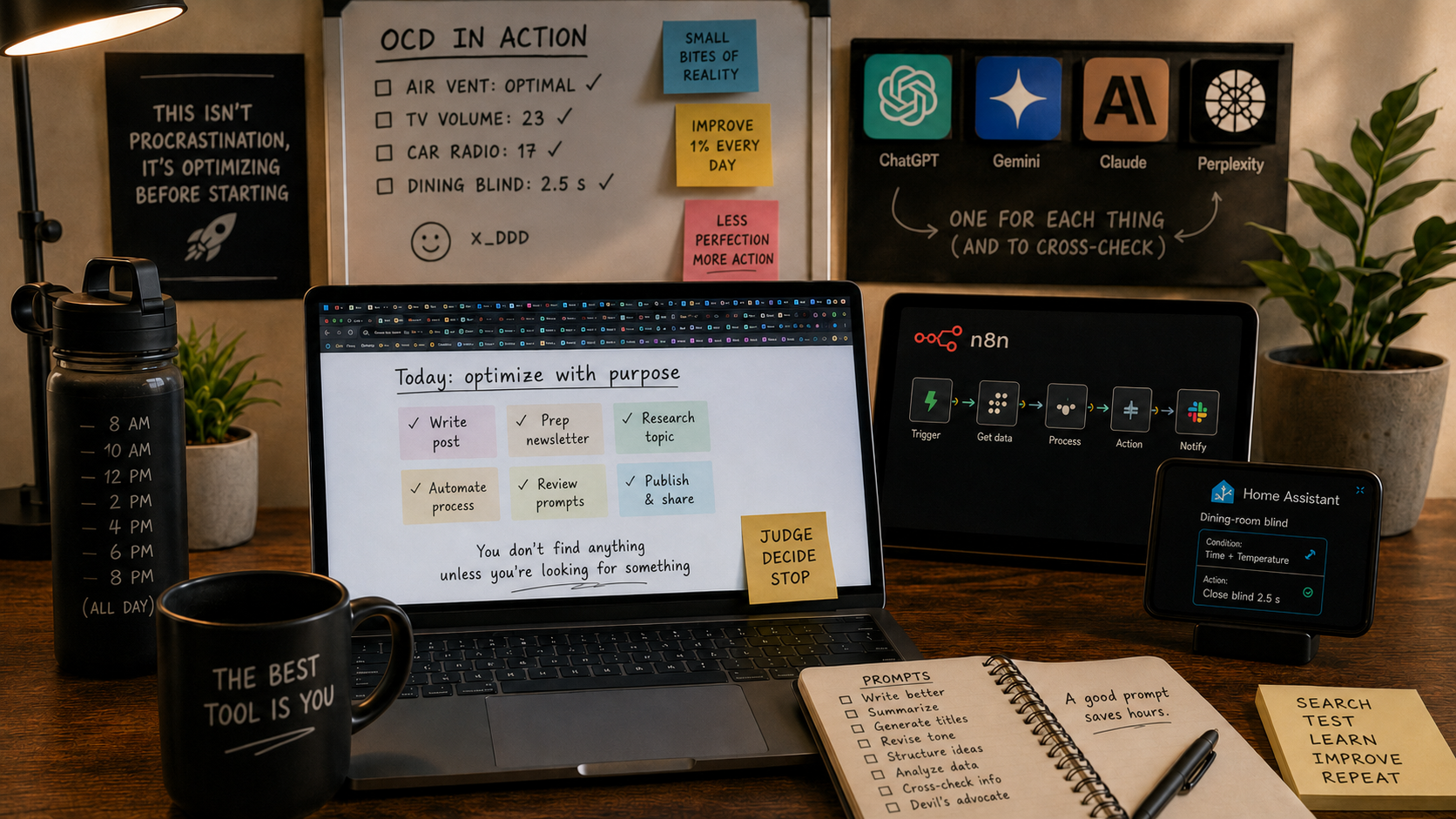
Not long ago, I spent almost an hour automating a task I do once every two months.
When I finished, I felt reasonably proud.
I had managed to save exactly thirty seconds.
If all goes well, I will recover the investment sometime around the year 2043.
As long as, by then, another essential tool has not appeared promising to do the same thing, but with a nicer interface.
The ultimate tool
I have a complicated relationship with tools.
They fascinate me.
They entertain me.
They make me imagine better processes.
And sometimes they make me lose an amount of time that is absolutely incompatible with the reason I started using them in the first place.
I have tried task managers.
Note-taking apps.
Automations.
Browser extensions.
Artificial intelligence models.
Systems for organizing systems.
And, of course, tools for evaluating other tools.
Because there can always be a slightly better way to do something.
That is the problem.
And also the beauty of it.
From dozens of tabs to hundreds
For years, I was one of those people with too many tabs open in the browser.
Dozens.
Many.
Too many.
But now Chrome manages my MacBook's memory better.
And since technology moves forward, so do I.
I have gone from dozens to hundreds.
They are not open tabs.
They are suspended possibilities.
Articles I will read.
Ideas I will review.
Tools I will compare.
Documentation I may need.
Videos I will never watch, but that somehow reassure me simply by being there.
The browser is not a tool.
It is a graphic representation of my curiosity with closing issues.
AI against AI
Something similar happens to me with artificial intelligence.
I use ChatGPT.
Gemini.
Claude.
Perplexity.
Sometimes one for writing.
Another one for contrasting.
Another one for looking up context.
Another one to play devil's advocate.
And, in especially glorious moments, I ask one AI to help me build a prompt to ask something from another AI.
Then, if I still have doubts, I can ask a third one which of the first two understood what I wanted better.
I do not know if this is advanced productivity or a committee meeting with avatars.
But I admit I love it.
My prompt Sheet
I also have a Google Sheet with prompts.
Prompts for tasks.
Improved prompts.
Prompts waiting to be improved.
Prompts I probably no longer use, but that I do not delete because one day they might save my professional life.
It is a kind of mental pantry.
Like someone keeping cables in a drawer.
You do not know exactly what all of them are for.
But the day you need one, you had better have it.
The problem is that sometimes I spend more time improving the prompt than solving the task the prompt was supposed to solve.
That is when you start to suspect that productivity also has a sense of humor.
n8n and the art of automating automation
Then there is n8n.
A wonderful tool.
Extremely dangerous.
Because when you discover it, you do not think:
“Great, I am going to save time”.
You think:
“I could lose a tremendous amount of time here in a technically very elegant way”.
And for some profiles, that is almost irresistible.
There is something deeply satisfying about automating tasks.
Seeing how one action triggers another.
How data moves from one place to another.
How an alert arrives exactly when it should.
It is like building an electric train set for adults who work with APIs.
And yes, sometimes you automate something that would have been faster to do by hand.
But it would not have been as beautiful.
Home Assistant and the dining-room blind
My relationship with Home Assistant also deserves a chapter of its own.
I have iterated automations to decide the best option depending on the time of day, the local temperature or a combination of both.
For example, to close the dining-room blind for a few seconds.
Not too much.
Not too little.
The right amount.
For the right number of seconds.
Under optimal conditions.
Because, of course, mid-afternoon sun in July is not the same as a moderate outdoor temperature with a suspicious thermal sensation.
Some people see a blind.
I see a decision system.
And that is where the problem begins.
My small negotiations with the universe
This does not only happen to me with technology.
I also have small everyday negotiations with the universe.
The air vents, for example.
If they are not pointing exactly where I think they should point, nothing happens.
The world keeps turning.
Life goes on.
But I adjust them.
Because there is a clearly optimal position.
And someone had to defend it.
Then there is the volume on the television.
Or on the car radio.
There are good numbers.
And bad numbers.
Do not ask.
I could not explain it either.
But I know.
And while I fill a water bottle, my mind usually starts thinking about what else I could do during those thirty seconds.
Sometimes I find something useful.
Other times I end up with two tasks started, none finished and a half-full bottle.
Small bites of reality.
We all have our own.
Mine simply come with a small mental dashboard.
Optimizing can also be procrastinating
There is a very fine line between improving a process and avoiding getting started.
And I have crossed it more times than I would like to admit.
Organizing folders.
Renaming files.
Comparing tools.
Redesigning a workflow.
Improving a prompt.
Adjusting an automation.
Changing a template.
All of that can be useful.
But it can also be a very sophisticated way of not facing the main task.
Modern productivity has a lot of that.
In the past, we procrastinated by looking out the window.
Now we procrastinate by configuring integrations.
It looks more professional.
But it is not always so.
The tool does not decide
Having said all this, I do not want it to sound like I am against tools.
Quite the opposite.
We have never had so many possibilities.
It has never been so easy to learn.
To test.
To compare.
To automate.
To build something that, in the past, would have required much more time, more budget or a bigger team.
Tools matter.
A lot.
But they do not decide for you.
A bad decision made with an extraordinary tool is still a bad decision.
A mediocre prompt in a brilliant AI is still a mediocre prompt.
An automation without judgment only makes the error arrive faster.
A good tool multiplies judgment.
It does not replace it.
The best tool is you
Many years ago, in a presentation about SEO, I used an idea that I still believe is deeply true:
The best tool is you.
Back then, I was talking about SEO.
Today I could be talking about AI.
About productivity.
About automation.
About any system that promises to make your life easier.
Because the most important tool is not the one you install.
It is the one that decides what is worth installing.
The one that asks why.
The one that knows when to stop.
The one that distinguishes between improving a process and hiding behind it.
The one that understands that not everything that can be automated should be automated.
And that not everything that can be measured matters.
You do not find anything unless you are looking for something
I have also been repeating another phrase for many years:
You do not find anything unless you are looking for something.
I think that phrase explains my relationship with technology quite well.
I keep searching.
Tools.
Ideas.
Different ways of doing things.
Some searches lead nowhere.
Others make me waste time.
A few completely change the way I work.
But all of them force me to learn something.
And maybe that is the real engine behind my p'alantismo.
Not the obsession with finding the perfect tool.
But the conviction that there is almost always a possible improvement.
Even if it is small.
Even if it is absurd.
Even if it only serves to confirm that the previous way was already good enough.
Amplified judgment
I will keep trying new apps.
I will keep installing extensions.
I will keep comparing AI models.
I will keep adjusting prompts in a Sheet.
I will keep thinking about how to save twenty seconds while filling a water bottle.
And I will probably keep having preferred numbers for the TV volume.
You know me.
But I try to remind myself of one thing.
The tool was never ChatGPT.
Nor Claude.
Nor Gemini.
Nor Perplexity.
Nor n8n.
Nor the next app that will appear next week promising to save another 3.7% of productivity.
The best tool is still you.
Everything else only amplifies the judgment with which you decide to use it.
Now, if you will excuse me...
I have just discovered a new tool that promises to automatically organize all the tools that promise to automatically organize my work.
I think I will just take a quick look.
You know how this ends.
Frequently Asked Questions (FAQs)
- How can you tell if a tool really saves time?
A good way is to measure the full cost: learning, setup, maintenance and real use. If it only saves time in theory, it may not be an improvement.
- When does automation become procrastination?
When you spend more energy perfecting the system than solving the original problem. Automation makes sense if it frees up attention, not if it creates yet another task.
- Does it make sense to use several different AIs?
Yes, if each one brings something different: contrast, depth, speed, search or critical review. The problem is not using several tools, but not knowing what you use each one for.
- What is the best productivity tool?
The one that fits your judgment, your context and your real way of working. The tool does not replace the decision; it amplifies it.
