Google’s Famous Search Golden Triangle (and Why It Still Matters in 2026)
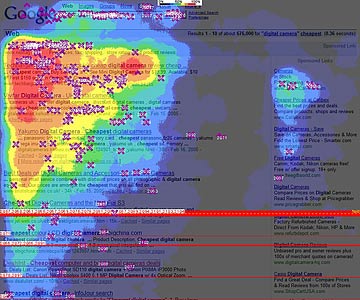
I first wrote this post in 2006, when eye-tracking studies were reshaping our understanding of how people actually looked at Google’s search results. The internet was a different universe: no mobile, no AI, no rich snippets — and a very young Google.
Even so, the iconic Google Search Golden Triangle became one of the most influential heatmaps in SEO history. And although it has aged (as have we all since 2006), it still teaches something essential: attention is limited, and humans focus where value appears instantly.
1. The original “Golden Triangle”: when everything happened in the top-left corner
The study — powered by early eye-tracking technology — revealed a consistent pattern: users scanned the results page forming a triangle concentrated in the upper left area.

Visibility by position (2006):
- Rank 1: 100%
- Rank 2: 100%
- Rank 3: 100%
- Rank 4: 85%
- Rank 5: 60%
- Rank 6: 50%
- Rank 7: 50%
- Rank 8: 30%
- Rank 9: 30%
- Rank 10: 20%
In other words: ranking high wasn’t just beneficial — it was decisive.
2. What has changed since then (and why the triangle isn’t a triangle anymore)
Google is no longer a simple list of blue links. Today it’s a mosaic: AI answers, videos, maps, FAQs, carousels, product listings, and layouts that didn’t exist two decades ago.
Then came mobile — and with it, a new behaviour pattern: less triangle, more fast vertical scanning.
Today, user behaviour tends to be:
- vertical,
- block-based,
- influenced by visual elements,
- shaped by answers that “solve” before a click is needed.
Yet the core truth remains: the top positions still concentrate most of the attention.
3. The other Golden Triangle: the three foundational SEO pillars
The term “Golden Triangle” also describes the three essential components of any solid SEO strategy:
- On-Page SEO: content, intent, HTML, architecture.
- Off-Page SEO: authority, mentions, backlinks.
- Technical SEO: speed, indexing, accessibility, structure.
If any of these pillars fails, rankings become unstable. If all three work together, everything else gets easier.
4. Why the Golden Triangle still matters in 2026
Because it brings together two timeless truths:
- how humans look at information
- and how we optimise so they can find us.
SERP layouts evolve. Human nature… not so much.
With AI-generated answers now in the mix, SEO also depends on semantic visibility: mentions, entities, presence in models and summaries.
5. Personal closing (2026)
Re-reading this post almost twenty years later reminded me how much SEO has changed — and how the essentials haven’t: understanding people before understanding algorithms.
The Golden Triangle may no longer have sharp edges, but its lesson survives: the game of attention still starts in the same place — wherever someone looks first.
