Writing with AI without letting it write for me
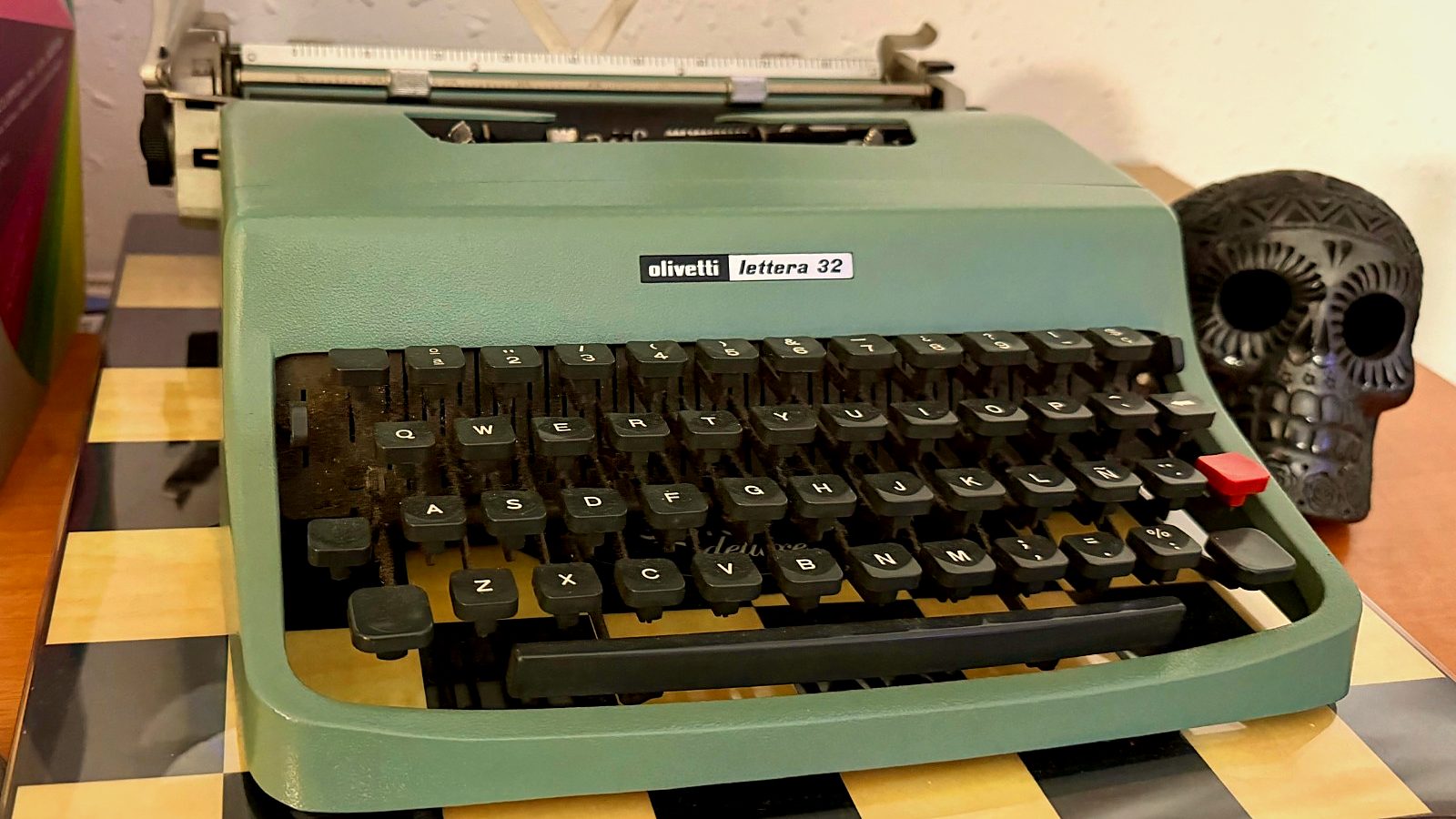
In the living room at home, next to the TV, there’s an Olivetti Lettera 32 resting on a chessboard.
I typed some of my secondary-school assignments on it, back when doing research meant going to the library.
Today I write this blog with the help of artificial intelligence.
It feels honest to say so. And it feels just as important to explain how, because there’s a difference I try hard to look after: writing with AI is not the same as letting AI write for me.
Long before AI, I was already writing
When I think back, I’ve written quite a lot. Almost always by hand.
The diary they used to give you for your first communion.
Stories my cousin Iris and I left half-finished when we were little.
Essays and poems that won me more than one Sant Jordi contest at school. And the odd dedication in my first attempts at flirting, which I’d rather not go into.
Philosophy text commentaries. Well-organised notes at secondary school, which did the rounds of the photocopier. At university, I was the one doing the photocopying, no point denying it.
Dedications on class graduation photos. A few letters with friends from summers in Beseit, sent to cities with faraway postcodes.
And notebooks. Lots of notebooks, in every job, as an employee and as an entrepreneur: meeting notes, ideas, lists, arrows only I understand.
Then came digital: song lyrics and ideas spread across my computer, tablet and phone. A book of questions so my father can tell us the story of his life. The outline, characters, plot and several passages of a novel I started years ago, titled 1/3 del viaje (“A third of the journey”).
And, above all, emails and specifications. For development teams of every size and, over the last four years, for language models: instructions, prompt variations, tests, tweaks, another round.
I’m not telling you this to show off. I’m telling you because writing has always been my way of putting my thoughts in order. The sentence that best sums up this blog is pretty clear to me: I write to understand, not to impress.
And understanding is exactly what I don’t want to delegate.
What I try to keep mine, always
When I write a post, there are five things I make sure come from me and nobody else.
The idea
A model can suggest a hundred topics in ten seconds. What it can’t tell me is which one matters to me now, or why. The idea is the reason a text exists, and that reason has to be mine.
The structure
The order in which I tell things is also a decision. Where I start, what I leave for the end, what I explain and what I let the reader work out.
The tone
How the text sounds. Whether it has humour, or allows itself a doubt. It’s the first thing to go when someone else writes the text, and probably the first thing anyone who knows me would notice.
What I’ve lived
The anecdotes, the memories and the quotes.
This is where the most serious risk lies: an AI can make up a believable anecdote in a second, with details and even a moral. That’s why there’s one non-negotiable rule on this blog: no invented experiences.
In the previous post, Learning to lose without falling apart, the game against Penya where we scored two points and that half-time with the junior team were remembered and told by me. AI helped me put them in order. Not a single one of those details came from it.
The final review
Whatever gets published, I review and sign. If something doesn’t represent me, it doesn’t go out.
What I do use AI for
I have no problem saying so. I use it to:
- Turn my notes, memories and outlines into a first draft that I then review and rewrite.
- Check whether I’ve already written something similar, so I don’t repeat myself.
- Translate the posts into Catalan and English, with review.
- Check facts and sources before quoting them.
- Handle the technical side: formatting, tags, images and publishing.
- Prepare the versions for social media.
It’s like working with someone incredibly fast and with a very good memory, to whom you have to explain very clearly what you want, and whose work you have to review in full.
Put like that, it’s quite similar to what I’ve been doing for years with development teams. Writing good instructions for a machine is writing too. I said as much when talking about the importance of explaining well: a clear text is an interface.
The traces AI leaves behind
There’s a problem I know well from my work: generated texts leave traces.
So many that Wikipedia has a whole page, and not exactly a short one, devoted to them: Signs of AI writing. It’s maintained by the editors themselves to spot generated articles, and it lists grandiose turns of phrase such as “stands as a testament” or “plays a vital role”, lists that always come in threes, and other patterns that keep coming back.
Others are just as easy to spot, and I recognise some of them straight away:
“Plays a key role.”
“In an ever-changing world…”
“It’s not just X, it’s Y.”
“It’s worth noting that…”
And I’m not immune. Not long ago I realised that one phrase was being repeated far too often on this blog: “over the years”. Precisely since I started writing with the help of AI. (And I’m not even that old.)
In my line of work, reducing those traces is part of the job. You have to humanise the result as much as you can.
Let’s be fair, though: people have verbal tics too, in writing and in speech. Mine existed long before any language model. Having tics is human; what worries me is a text that ends up sounding like everyone and no one.
Piloting, even if not always well
If I had to sum up how I work with AI, I’d say I try to pilot it. With my judgement, my instructions and my supervision.
Sometimes I do it better, sometimes worse.
But I’m still the one deciding where we’re going. It’s the same idea I defended in The mistake of outsourcing your judgement to AI: the real risk isn’t that AI gets things wrong, but that you stop thinking.
What no AI is going to write for me
There are two unfinished texts that remind me of it.
One is 1/3 del viaje. At this rate, I’ll end up calling it 1/2 del viaje. If I ever finish it, I want it to be because I wrote it.
The other is the book of questions so my father can tell us the story of his life. I still haven’t given it to him. And no AI can do that for me either.
Maybe this post will help me remember.
Frequently asked questions about writing with AI
- Should you say when a text has been written with the help of AI?
On a personal blog there’s no single rule. I prefer to say it, because a reader’s trust is worth more than looking as if I did everything alone. In the media, in companies or in informative texts, it’s worth checking the rules and policies that apply in each case.
- Do AI writing detectors work?
Not very well. They get it wrong in both directions: they flag texts written by people as artificial and let generated ones through. Wikipedia’s own guide to signs of AI writing advises against relying on automatic detectors. It works better to read carefully and ask whether the text says something concrete that only its author could have written.
- Does writing with AI make you a worse writer?
It depends on what you delegate. If you delegate thinking, organising your ideas or deciding what you want to say, that muscle weakens. If you use it to check, translate or review, it can help you write more and with fewer mistakes. That’s why I still take notes by hand in notebooks.
- Are AI translations reliable?
They’re a good starting point, but they need reviewing by someone who knows the target language well. Nuances of meaning (in English, the Spanish “criterio” may be judgement rather than criterion), the rules of each language (in Catalan, for instance, the IEC’s 2016 reform of diacritic accents) and register are exactly what slips through most.




The comments could not be loaded. If you use an ad or tracking blocker, try allowing Disqus on this site.
Comments use Disqus, an external service that sets its own cookies.